Research guide · Tbilisi
Tbilisi: neighbourhoods, sights and getting there for 3 to 4 days
Which area suits you, how bus 337 takes you from the airport to the centre from 1 GEL, what the metro and entry fees cost, and when Tbilisi is at its best.
By Nighthopper editorial teamCreated with AITranslated with AIPublished Updated 13 min read
How this article was made
This English version was translated from the German original with AI and has not been reviewed by a person. The checks described here refer to the German original, which is authoritative.
Text created with AI and checked with AI against the sources listed. Approved by Simon Misiak on .
Editorially responsible: Saimon Misiaki (Simon Misiak).
At a glance
- Best time to visit: September and October with daytime highs of 26.7 and 20.2 °C; July and August above 31 °C
- Airport TBS 17 km south-east: bus 337 from 1 GEL in around 60 min or airport taxi from 40 GEL (Sept. 2026)
- 3 days for the Old Town, Sololaki, Mtatsminda and Sameba, 1 day for Mtskheta by marshrutka from Didube
- Currency lari (GEL), €1 = 2.99 GEL (Sept. 2026); card payment is widespread, also on buses and the metro
- Public transport: 1 GEL per 90 minutes with a Metromoney card, around 1.50 GEL with a foreign bank card (Sept. 2026)
- Not for you if you avoid heat or steep paths; Rustaveli Avenue is a building site until the end of Nov. 2026
Getting there from Germany
Airport: Tbilisi (TBS)
| From | As the crow flies | Compensation up to |
|---|---|---|
| Frankfurt (FRA) | 2,935 km | €400 |
| Munich (MUC) | 2,688 km | €400 |
| Berlin (BER) | 2,636 km | €400 |
| Düsseldorf (DUS) | 3,072 km | €400 |
| Hamburg (HAM) | 2,898 km | €400 |
Compensation per person under the EU air passenger rights regulation (Regulation (EC) No 261/2004) if the flight arrives 3 hours late or more, or is cancelled less than 14 days before departure — not in extraordinary circumstances such as severe weather. Check whether you’re owed anything →
- Time difference:
- +2 hours
Straight-line distance: our own calculation from airport data (OurAirports).
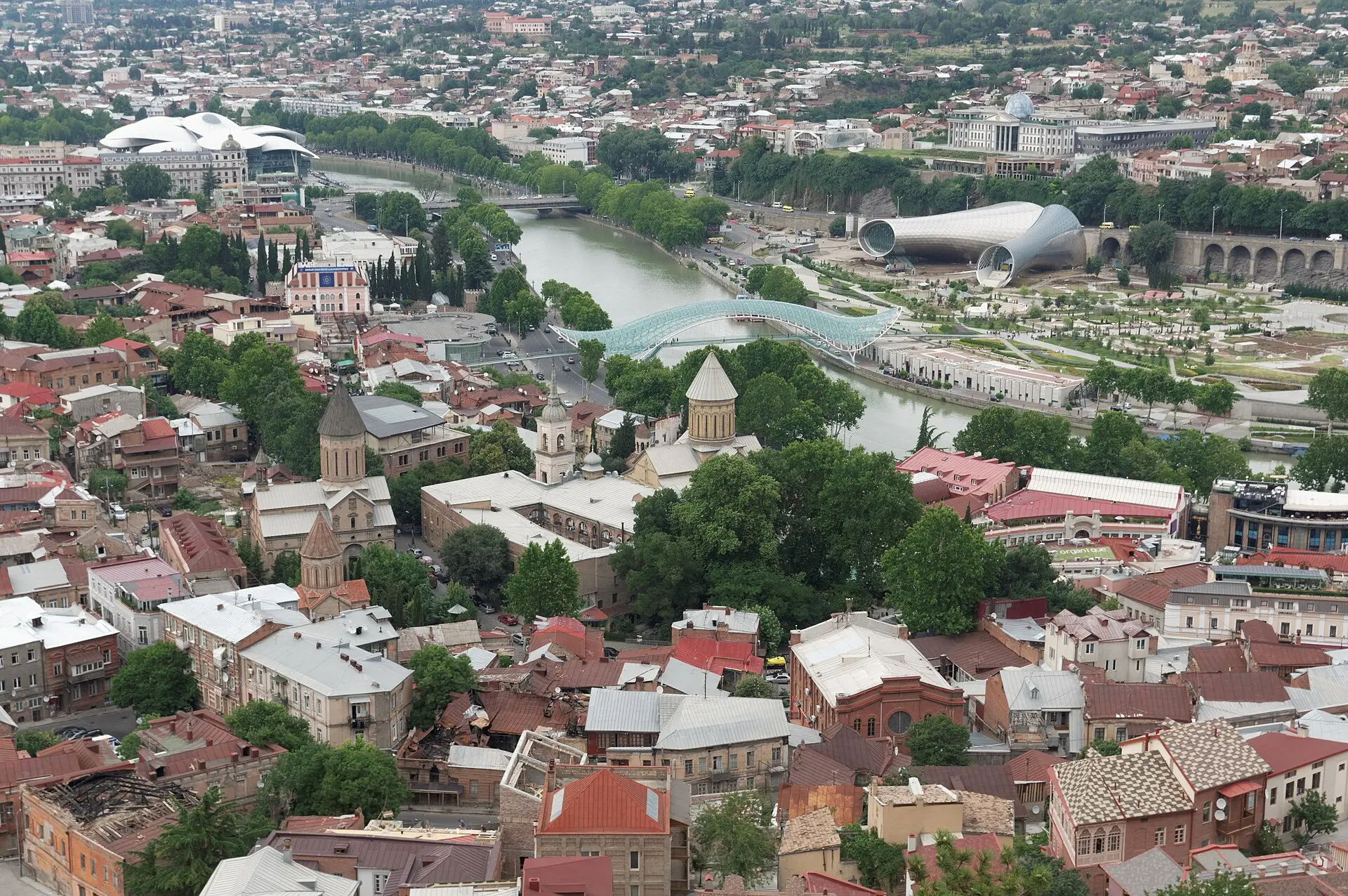
Tbilisi, also known as Tiflis, is the capital of Georgia: with 1,369,400 inhabitants (as of 1 January 2026), more than a third of the country's population lives here. Packed into a small area are sulphur baths beneath a fortress whose origins reach back to the 4th century, a basilica from the 6th century and town houses with painted entrance halls. The city suits you if you want to spend three days on foot and do not mind slopes; for a fourth day, Mtskheta lies around 20 km to the north.
Advice from the German Federal Foreign Office
The German Foreign Office strongly advises against travel to Abkhazia, South Ossetia and the immediate vicinity of the conflict regions. According to the Foreign Office, protests continue to take place regularly in Tbilisi and other larger cities, in the capital mostly in front of the Parliament on Rustaveli Avenue. Violent clashes cannot be ruled out, so avoid demonstrations and large crowds. Since 1 January 2026 you have had to show proof of foreign health insurance with at least 30,000 GEL of cover for the whole stay when entering the country. The confirmation may be printed or digital, in English or Georgian.
AI-generated summary of the German Federal Foreign Office’s travel and safety advice for Georgia, version of 20 February 2026. It simplifies and may be incomplete: before you travel, also read the Foreign Office’s original text (in German).
Original text from the German Federal Foreign Office (in German) (opens in a new tab)Getting there and from the airport into the city
Tbilisi Airport (TBS) is around 17 km south-east of the centre. The “At a glance” box shows you the straight-line distance and the time difference.
Bus 337: into the centre from 1 GEL
The stop is in front of the departures hall: from the arrivals hall, walk right to the end of the neighbouring building, where you will find a blue bus sign and a display board. Line 337 normally runs via Rustaveli Avenue and Freedom Square to Station Square (Sadguris Moedani), where you can change to both metro lines. According to the airport it runs from about 07:00 to 23:00 and not at all at night (as of September 2026).
The bus comes roughly every 15 to 20 minutes and takes around 60 minutes to the centre (as of 2026). With a Metromoney card the journey costs 1 GEL; with a foreign bank card or phone wallet it costs around 1.50 GEL according to Wander-Lush (as of September 2026). You hold your card or phone against the reader when boarding; real-time departures are shown on the TTC portal transit.ttc.com.ge (opens in a new tab).
There are no Metromoney cards at the airport, only the blue transport card at the Bank of Georgia counter. It starts with a day pass for 3 GEL, so for a single journey your own bank card is cheaper.
Caution
Rustaveli Avenue: roadworks until the end of November 2026
Since 23 July 2026, Rustaveli Avenue has been undergoing renovation between Tamar Chovelidze Street and Freedom Square, and it is due to be finished at the end of November 2026. Since 11 September traffic has been moving again between Tamar Chovelidze Street and Mikheil Javakhishvili Street, while the rest remains closed to vehicles (as of September 2026). According to the City Hall, more than 20 bus and minibus lines, including bus 337, are being diverted via Heroes' Square and the right bank of the Mtkvari (as of July 2026). Check the stop before you travel and allow a time buffer.
Airport taxi and Bolt
The official airport taxi runs around the clock at a fixed price: 40 GEL for journeys of just under 20 km, including the Old Town, Sololaki, Mtatsminda and Chugureti. Destinations further away cost 50 GEL, which according to Wander-Lush usually already includes Vake, Saburtalo and Didube (as of September 2026). The taxi rank is at the kerb in front of the arrivals hall; depending on traffic you will be in the centre in 20 to 30 minutes.
With Bolt you pay around 30 to 40 GEL into the centre (as of 2026). The app shows the pick-up point and final price before the journey starts, and you check the vehicle details before getting in. Steer clear of street taxis without an app, where inflated prices are a risk.
Neither trains nor the metro go to the airport
The airport has had a rail connection since 2007, but the Georgian Railway timetable lists no airport service (as of September 2026). The railway line from Samgori to the airport announced in 2018 was never started.
Flight delayed or cancelled?Check whether you’re owed money under the EU air passenger rights regulation — with every step of the check in plain language.Where to stay: the neighbourhoods compared
The historic core of Tbilisi covers only around 2 km² and dates back to the early Middle Ages. Most of the sights are in it or on the slopes above it, so the neighbourhood decides above all about walking distances and gradients.
| Neighbourhood | Location | Suits | Drawback |
|---|---|---|---|
| Old Town with Abanotubani | right bank of the Mtkvari, below the Narikala fortress | short distances to baths, Sioni Cathedral and the Bridge of Peace | steep path up to the fortress |
| Sololaki | at the foot of Mtatsminda | town houses from the mid-19th century, valley station of the funicular | hillside location, many buildings still unrenovated |
| Mtatsminda | mountain above Sololaki, top station at 727 m | views, Mtatsminda Park, Pantheon | downhill on foot or by funicular with its own card |
| Vake | south-west, right bank | residential area with Vake Park and Mziuri children's park | no metro |
| Around Fabrika | a few blocks from Marjanishvili metro | cultural centre with courtyard, cafés, bars and studios | bars operating in the courtyard, metro to the Old Town |
Swipe the table sideways to see all columns.
Abanotubani means “bath district”. It lies above sulphur springs, used to be the district of craftsmen and dyers, and has been undergoing state-led renovation since the 1970s.
Sololaki came into being after the laying out of Freedom Square in the 1820s, and from the mid-19th century the middle classes lived here. In Soviet times 10 to 15 families shared one house. So far only individual houses and entrances have been renovated, for example at Galaktioni Street 13 and 18 and Ivane Machabeli Street 17.
Vake is one of the largest residential areas in the city, has been part of Tbilisi since 1906 and was built up from the 1920s onwards. A third metro line was meant to connect the neighbourhood, but its construction sites have stood idle since Soviet times.
Fabrika, at Egnate Ninoshvili Street 8, was a Soviet sewing factory. Since July 2016 it has been a cultural centre with studios, shops and a record shop.
Sights: three days in the city
Day 1: Baths, Narikala and the Bridge of Peace
According to legend, King Vakhtang Gorgasali founded the city because of the hot sulphur springs; the name comes from the Georgian “tbili” for warm. In the 12th century there were around 65 baths, in the 19th century still 6, recognisable by their brick domes. The best known is Chreli Abano, the Colourful Bath from the 17th century with a tiled façade, where you book massages in addition to the bath. Others include Bath No. 5, the Royal Bath and public baths.
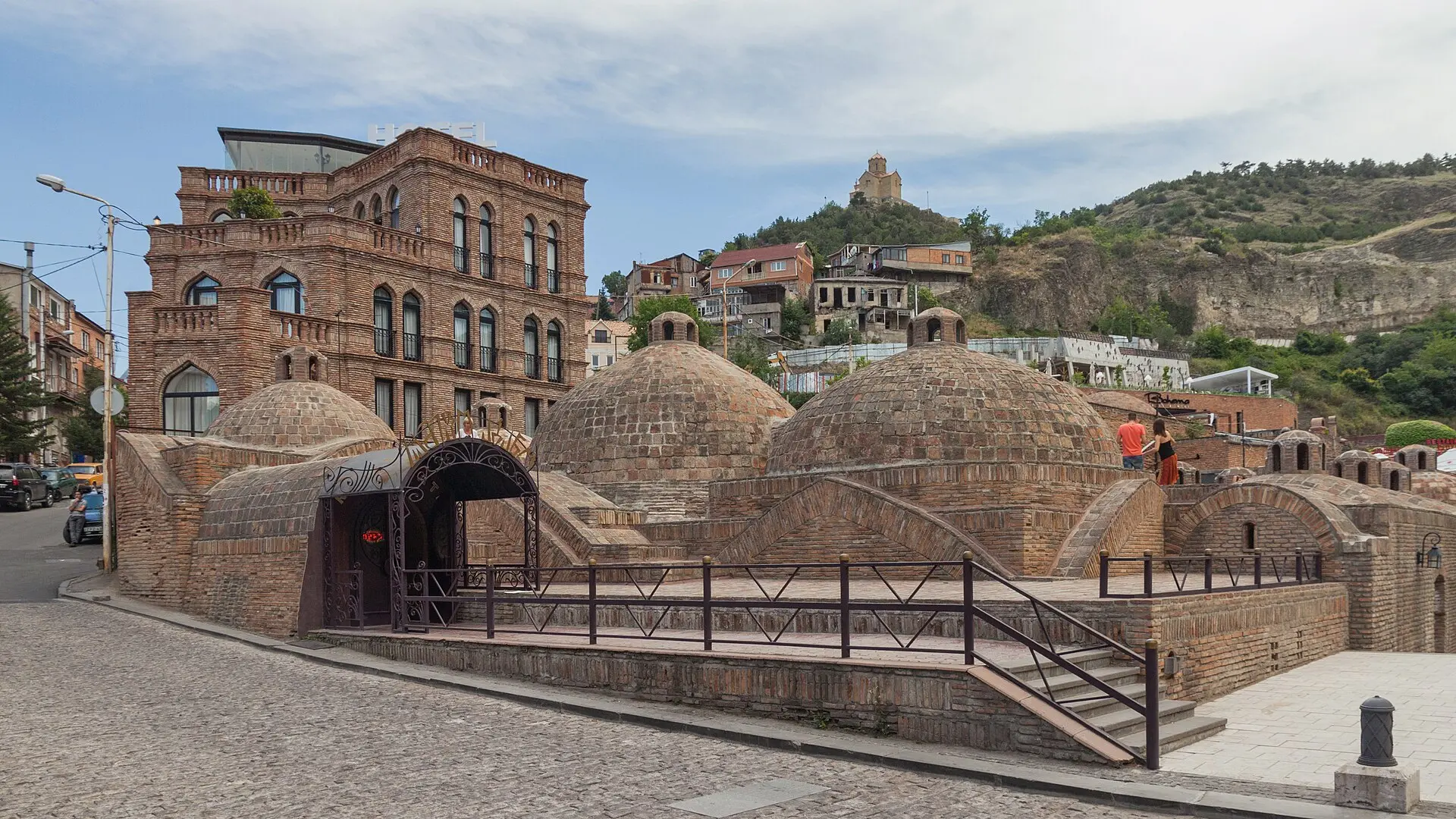
Right beside Abanotubani are the Leghvtakhevi Waterfall in the gorge and the 18th-century Juma Mosque. Besides the mosque, the Old Town has Orthodox, Armenian and Catholic churches as well as two synagogues.
Above the neighbourhood, the Narikala fortress stands on a steep hill. St Nicholas Church in the lower courtyard was rebuilt in 1996/97. You can spare yourself the climb by taking the cable car from Rike Park: 2 to 3 minutes' ride, 2.50 GEL each way with the Metromoney card (as of July 2026).
Five minutes' walk from Narikala stands Kartlis Deda, the Mother of Georgia: 20 m high, a work by Elguja Amashukeli. For the city's 1,500th anniversary in 1958 the figure was first erected in wood, and in 1963 it was given an aluminium covering. She holds a bowl of wine for hospitality and a sword to ward off enemies. On foot, a staircase also leads up from Betlemi Street.
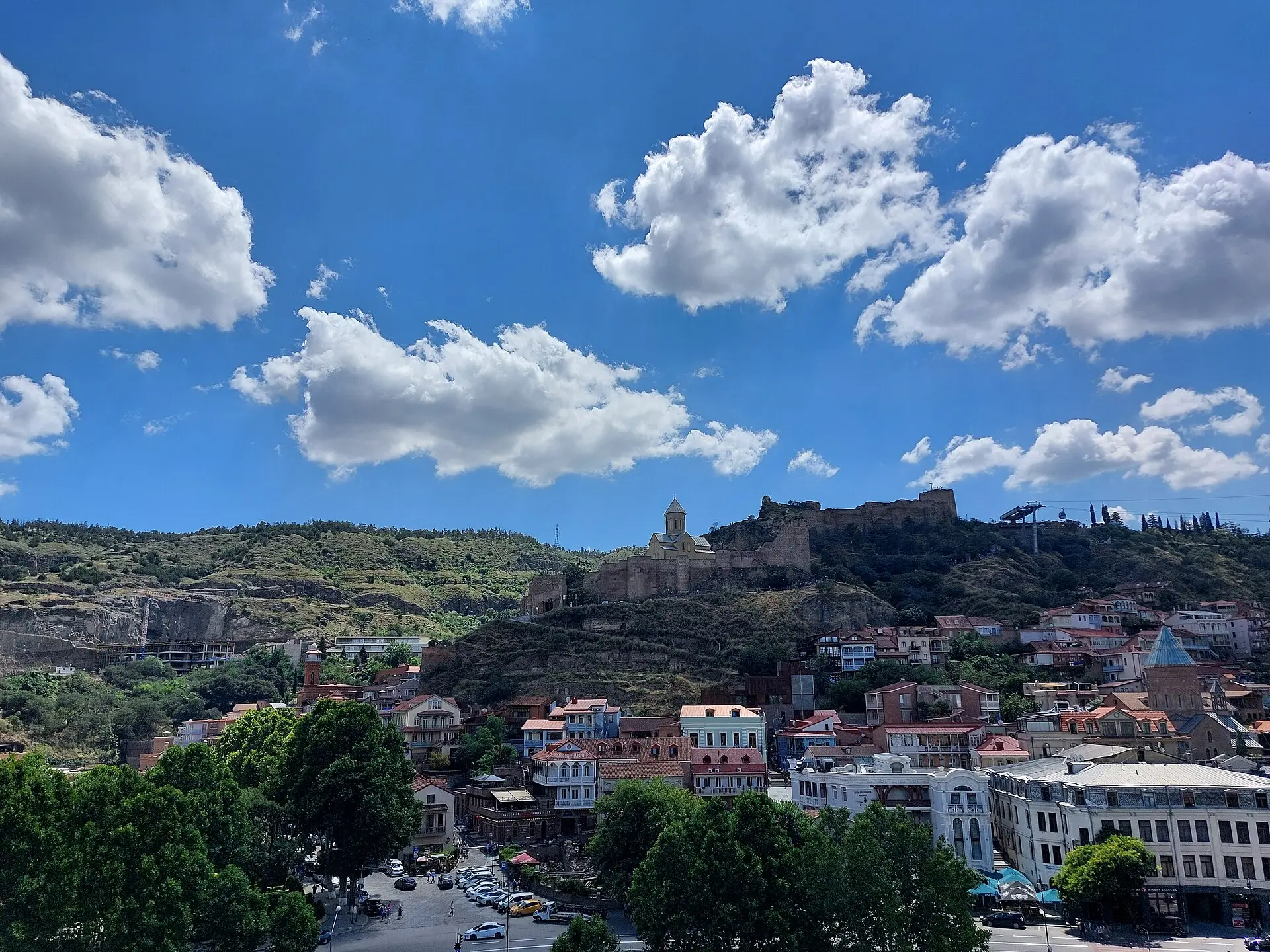
Down below, the Bridge of Peace, 150 m of steel and glass by Michele De Lucchi, has connected Erekle II Street with Rike Park since 6 May 2010. LED light programmes run from 90 minutes before sunset, so early evening is a good time to cross. On the rock above the Mtkvari stands Metekhi Church with the equestrian statue of Vakhtang Gorgasali and a panoramic view over the city.
Day 2: Churches of the Old Town, Sololaki and Mtatsminda
The Anchiskhati Basilica from the 6th century is the oldest surviving church in the city. Until the consecration of Sameba in 2004, the Georgian Patriarch had his seat at Sioni Cathedral. The first buildings of Sioni date from the 6th and 7th centuries; after several destructions, what stands today follows the version from the 13th century.
In Sololaki it is all about doorways: marble, wall painting and wrought iron, eclectic, Moorish or in the Modern style of 1900 to 1915. The style with ornate façades and painted entrance halls is called “Tbilisi Modern”.
At Chonkadze Street 22 the funicular up Mtatsminda departs, in operation since 1905: 501 m long, around 5 minutes' ride to the top station at 727 m. For this you need a rechargeable Mtatsminda Park card for 2 GEL from the ticket office at the valley station; the ascent and the descent are debited separately (as of July 2026).
At the intermediate stop lies the Pantheon in the churchyard of St David's Church (Mamadaviti), opened in 1929, with the graves of Ilia Chavchavadze, Alexander Griboyedov and Nino Chavchavadze, among others. At the top lies Mtatsminda Park, covering around 100 ha, with a 65 m Ferris wheel, a roller coaster and water slides.
Day 3: Rustaveli Avenue, Dry Bridge and Sameba
On Rustaveli Avenue stand the Parliament, the opera house, the National Gallery and theatres. The National Museum (Simon Janashia Museum of Georgia) at number 3 shows finds from the Stone Age through the Middle Ages to ethnography and coins. It is open Tuesday to Sunday from 10:00 to 18:00; foreign adults pay 40 GEL, foreign students 15 GEL (as of September 2026).
At the Dry Bridge near the Presidential Palace there has been a flea market since the 1950s with Soviet objects, old coins, silver jewellery and crockery. In the park next to it is an open-air art market.
The Holy Trinity Cathedral Sameba on Elia Hill replaced Sioni as the main church of the Georgian Orthodox Church in 2004; construction began in 1995. Only two Orthodox cathedrals in the world are taller. From Avlabari metro station you walk 10 to 15 minutes uphill, and entry is free. Shoulders and knees must be covered, and women wear a headscarf (as of September 2026).
Day trip to Mtskheta
Since 1994, three church buildings have been part of the UNESCO World Heritage Site ‘Historical Monuments of Mtskheta’. They are the Samtavro Monastery from the 4th century, the Jvari Monastery from the 6th and the Svetitskhoveli Cathedral from the 11th. The Georgian Church has listed the town as a “Holy City” since 2014.
Mtskheta lies around 20 km north of Tbilisi, where the Aragvi and the Kura (Mtkvari) meet. From the 3rd century BC to the 5th century AD the kings of Iberia ruled from here; in the early 6th century King Dachi moved the seat to Tbilisi.
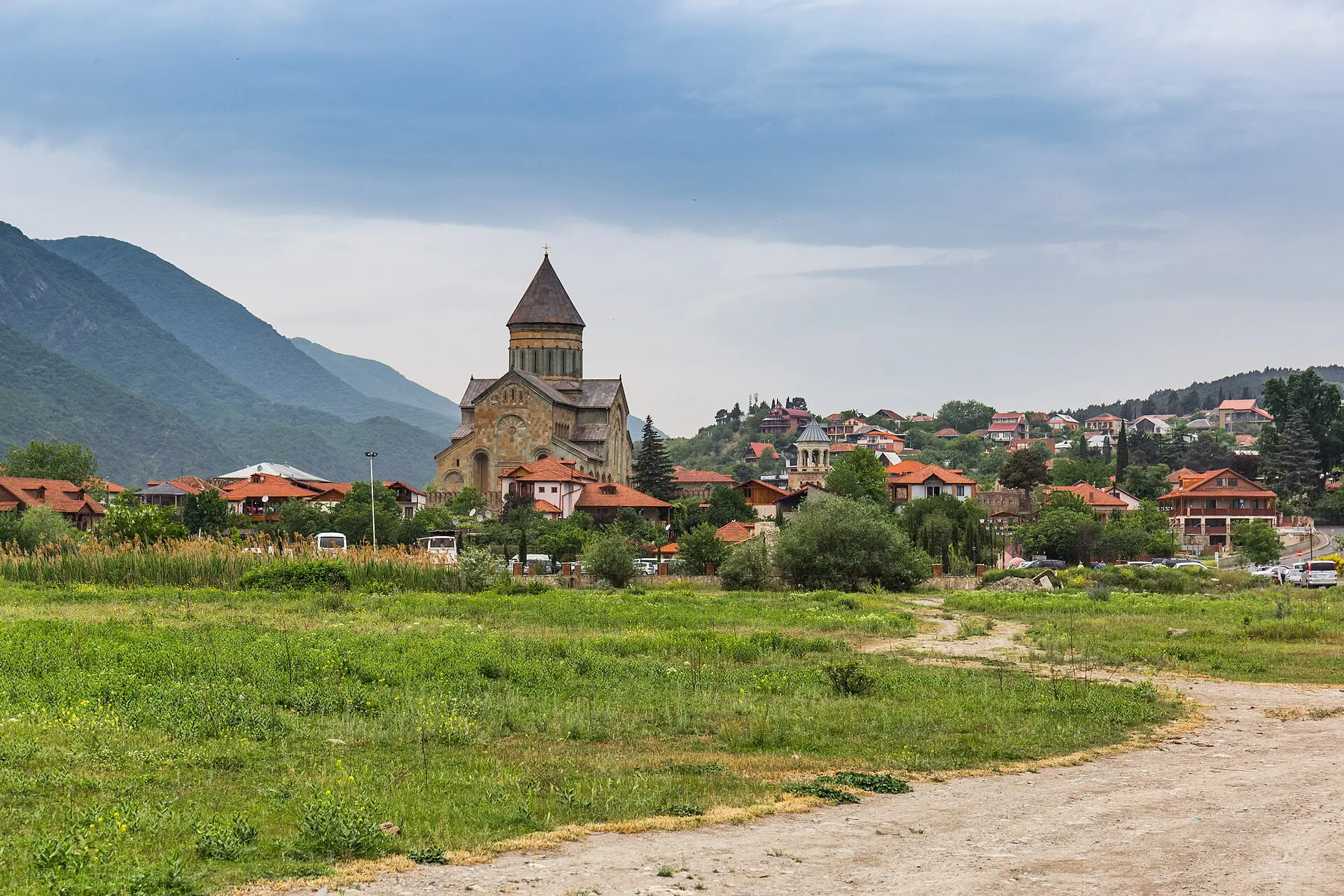
Take metro line 1 to Didube. At the bus station you buy a paper ticket for the marshrutka at the counter, around 2 GEL. It runs from about 08:00 every 20 to 30 minutes and takes 25 to 35 minutes (as of August 2026). The last marshrutka back usually leaves between 20:00 and 20:30 (as of June 2026).
No public transport goes to the Jvari Monastery; from Mtskheta you take a taxi. For other destinations in Georgia, a hire car from TBS airport is more flexible; in Tbilisi itself, the metro, bus and Bolt are enough.
Car hire at Tbilisi Airport (TBS)Latest price sample for each car class and rental company, plus the search for your travel dates.Food and drink
Khachapuri, the Georgian cheese bread, comes in just under 50 regional variants. The Imeretian form is round and baked in a pan, the Adjarian is boat-shaped with egg and butter; cheeses used include Imeruli and Sulguni.
Wine is traditionally made in the qvevri, an egg-shaped clay vessel that stays buried in the ground for 5 to 6 months. The method has been part of UNESCO's intangible cultural heritage since 2013.
Best time to visit
For city walks, September and October are best. In September the average daily high is 26.7 °C, and only 34.8 mm of rain falls on an average of 4.9 days. In October it is 20.2 °C, and there is also the city festival Tbilisoba, held since 1979 with folk music, dance and a harvest market for the grape harvest (Rtveli), mainly in the Old Town. The 2026 date had not been officially confirmed at the editorial deadline.
Spring is mild: in April the daily high is 18.8 °C, in May 23.9 °C. May and June are the rainiest months with 82.9 and 84.0 mm; in May it rains on an average of 10.4 days.
July and August are hot: the average daily high is 31.7 and 31.9 °C, and at night it only drops to around 20 °C. January is the coldest month at 7.1 °C by day and −0.4 °C at night, but with 16.4 mm it is also the driest. Data: WMO climate normals 1991 to 2020, Tbilisi station.
Costs
Georgia uses the lari (GEL). At the official rate of the National Bank of Georgia for September 2026 (€1 = 2.9925 GEL), 1 GEL is worth around €0.33.
| Item | Price | approx. in euros |
|---|---|---|
| Metro, bus or minibus with Metromoney card, 90 minutes incl. transfers | 1 GEL | €0.33 |
| Journey with a foreign bank card (according to Wander-Lush) | around 1.50 GEL | €0.50 |
| Time-based public transport pass (subscription card only): day / week / month | 3 / 20 / 40 GEL | €1.00 / €6.68 / €13.37 |
| Airport taxi up to just under 20 km / beyond (e.g. Vake) | 40 / 50 GEL | €13.37 / €16.71 |
| Bolt from the airport to the centre | 30 to 40 GEL | €10.03 to €13.37 |
| Cable car Rike Park to Narikala, each way | 2.50 GEL | €0.84 |
| National Museum, foreign adults / students | 40 / 15 GEL | €13.37 / €5.01 |
| Marshrutka to Mtskheta | around 2 GEL | €0.67 |
Swipe the table sideways to see all columns.
As of September 2026; cable car July 2026, marshrutka August 2026, Bolt 2026.
Practical information
Money and payment
In Tbilisi you pay by card or phone almost everywhere, you withdraw cash from ATMs, and you can also exchange euros for lari. The 90-minute fare on public transport is only available with a Metromoney card or a bank card.
Metro and Metromoney card
The metro, opened in 1966, has two lines with 23 stations over 28.6 km; the operator is the Tbilisi Transport Company (TTC). Line 1 connects Akhmeteli Theatre and Varketili over 16 stations, line 2 (Saburtalo) connects the State University and Station Square over 7 stations, where you change between the two. For visitors, the most important stations are Freedom Square (Tavisuplebis Moedani), Rustaveli, Avlabari, Marjanishvili and Station Square. The metro runs from just before 06:00 until midnight (as of September 2026).
Tip
One card for metro, bus and cable car
The Metromoney card costs 2 GEL (as of September 2026); you can get it at the metro ticket offices and at the cable car to Narikala. You can also top it up at Bank of Georgia machines. Keep the receipt: if you return the card within a month, you get the 2 GEL back. Only the funicular up Mtatsminda needs its own park card.
Electricity
Georgia has type C and F sockets. The German Schuko plug (type F) is standard, so you do not need an adapter.
Entry, safety and health
The current rules for Georgia are published by the German Foreign Office.
Entry requirements and safety
The rules that apply are published by the German Federal Foreign Office — always up to date there.
Travel and safety advice: Georgia (in German) (opens in a new tab)Who this is not for
- Anyone who copes badly with heat should avoid July and August: by day it averages over 31 °C, and around 20 °C at night.
- Anyone who dislikes walking uphill: Narikala is on a steep hill, to Sameba it is a 10 to 15 minute walk uphill from the metro, and Sololaki lies at the foot of Mtatsminda.
- Anyone landing late: after about 23:00 there is no bus 337, and from midnight no metro either; then you are left with the airport taxi or Bolt.
- Anyone travelling before the end of November 2026 must expect diversions around the roadworks on Rustaveli Avenue.
Sources and last update
- Wikipedia: Tbilisi International Airport (opens in a new tab), accessed 23 September 2026
- Tbilisi International Airport: Bus (opens in a new tab), accessed 23 September 2026
- Wander-Lush: Tbilisi Airport to City Centre (2026) (opens in a new tab), accessed 23 September 2026
- TTC: Standard tariff (opens in a new tab), accessed 23 September 2026
- TTC: Metromoney card (opens in a new tab), accessed 23 September 2026
- Civil Georgia: Rustaveli Avenue to Undergo Rehabilitation (21 Jul 2026) (opens in a new tab), accessed 23 September 2026
- Interpressnews: Tbilisi City Hall – Traffic on Rustaveli Avenue restricted (21 Jul 2026) (opens in a new tab), accessed 23 September 2026
- Georgia Today: Road reopened to traffic between Chovelidze and Javakhishvili streets (11 Sep 2026) (opens in a new tab), accessed 23 September 2026
- Tbilisi International Airport: Taxi (opens in a new tab), accessed 23 September 2026
- Bolt: Tbilisi airport Transfers (opens in a new tab), accessed 23 September 2026
Show all 45 sources
- Georgian Railway: Traffic General Schedule (opens in a new tab), accessed 23 September 2026
- Wikipedia: Tbilisi Metro (opens in a new tab), accessed 23 September 2026
- Georgia Travel (national tourism administration): Tbilisi (opens in a new tab), accessed 23 September 2026
- Georgia Travel: Abanotubani in Tbilisi (opens in a new tab), accessed 23 September 2026
- Georgia Travel: Tbilisi Sulfur Baths (opens in a new tab), accessed 23 September 2026
- Georgia Travel: Tbilisi, Sololaki District (opens in a new tab), accessed 23 September 2026
- Georgia Travel: The Funicular (opens in a new tab), accessed 23 September 2026
- Tbilisi Local Guide: Funicular Railway (opens in a new tab), accessed 23 September 2026
- Wikipedia: Mtatsminda Park (opens in a new tab), accessed 23 September 2026
- Wikipedia: Mtatsminda Pantheon (opens in a new tab), accessed 23 September 2026
- Wikipedia: Vake, Tbilisi (opens in a new tab), accessed 23 September 2026
- Fabrika Tbilisi (operator's website) (opens in a new tab), accessed 23 September 2026
- Wander-Lush: Fabrika Tbilisi (opens in a new tab), accessed 23 September 2026
- Wikipedia: Narikala (opens in a new tab), accessed 23 September 2026
- Tbilisi Local Guide: Rike–Narikala Cable Car (opens in a new tab), accessed 23 September 2026
- Georgia Travel: Kartlis Deda (opens in a new tab), accessed 23 September 2026
- Wikipedia: Bridge of Peace (opens in a new tab), accessed 23 September 2026
- Wikipedia: Holy Trinity Cathedral of Tbilisi (opens in a new tab), accessed 23 September 2026
- Tbilisi Local Guide: Holy Trinity Cathedral (opens in a new tab), accessed 23 September 2026
- Wikipedia: Anchiskhati Basilica (opens in a new tab), accessed 23 September 2026
- Wikipedia: Tbilisi Sioni Cathedral (opens in a new tab), accessed 23 September 2026
- Georgian National Museum: Opening hours (opens in a new tab), accessed 23 September 2026
- Georgian National Museum: Admission (opens in a new tab), accessed 23 September 2026
- Georgia Travel: Dry Bridge Flea Market (opens in a new tab), accessed 23 September 2026
- Wikipedia: Mtskheta (opens in a new tab), accessed 23 September 2026
- Wander-Lush: Didube Bus Station (Aug 2026) (opens in a new tab), accessed 23 September 2026
- OrbiTrip: Tbilisi to Mtskheta (Jun 2026) (opens in a new tab), accessed 23 September 2026
- Georgia Travel: Rediscovering Khachapuri (opens in a new tab), accessed 23 September 2026
- UNESCO: Ancient Georgian traditional Qvevri wine-making method (opens in a new tab), accessed 23 September 2026
- WMO Climate Normals 1991–2020, Tbilisi 37445 (NOAA NCEI, archived copy) (opens in a new tab), accessed 23 September 2026
- Wikipedia: Tbilisoba (opens in a new tab), accessed 23 September 2026
- German Foreign Office: Georgia – travel and safety advice (in German) (opens in a new tab), accessed 23 September 2026
- National Bank of Georgia: Official exchange rate EUR (opens in a new tab), accessed 23 September 2026
- WorldStandards: Plug & voltage Georgia (opens in a new tab), accessed 23 September 2026
- Geostat: Number of Population as of January 1, 2026 (opens in a new tab), accessed 23 September 2026
Information last checked on 28 September 2026.
Last change to the content on 28 September 2026: Added a box with the German Foreign Office's travel and safety advice.
Found a mistake? Write to us — we’ll correct it and note it here.