Research guide · South Korea
South Korea 2026: getting there, regions, KTX, best time to visit and costs
Planning South Korea: AREX from Incheon, seven regions, climate in Seoul and Busan, the new KTX from September 2026, palace admission, Hallasan and costs.
By Nighthopper editorial teamCreated with AITranslated with AIPublished 11 min read
How this article was made
This English version was translated from the German original with AI and has not been reviewed by a person. The checks described here refer to the German original, which is authoritative.
Text created with AI and checked with AI against the sources listed. Approved by Simon Misiak on .
Editorially responsible: Saimon Misiaki (Simon Misiak).
At a glance
- In 2025, 450,651 passengers boarded flights at the main German airports with South Korea as their last known destination, ranking 41st of 211 destination countries abroad (Federal Statistical Office, our own analysis).
- AREX direct train from Incheon airport to Seoul Station: 43 minutes from Terminal 1, 51 minutes from Terminal 2, 13,000 won for adults (as of September 2026).
- Since 1 September 2026 KTX and SRT run together as KTX; Seoul–Busan costs 54,400 instead of 59,800 won in standard class.
- Palaces in Seoul: Gyeongbokgung 3,000 won, combined ticket for four palaces and Jongmyo 6,000 won, free admission in a hanbok (as of September 2026).
- Hallasan on Jeju: you can reach the summit via Seongpanak or Gwaneumsa only with a reservation, bookable from 9:00 on the first working day of the previous month (as of September 2026).
- Departure tax: 7,000 won when leaving by air, children under 12 are exempt (as of September 2026).
South Korea suits you if you want to combine big city, palaces, temples and volcanic landscape and like travelling by train. UNESCO lists 17 World Heritage Sites in the country (as of September 2026). The fastest KTX runs from Seoul to Busan in 2 hours 18 minutes (timetable from 1 September 2026).
What is new in 2026 is above all the railway: since 1 September, KTX and SRT have run together as KTX, on average 10% cheaper according to Korail. In July the UNESCO World Heritage Committee met in Busan. Since May 2026, 1 May and Constitution Day on 17 July have also been public holidays.
South Korea is a poorer fit in high summer: in July Seoul receives on average 414.4 mm of rain (1991–2020). In January the mean minimum there drops to −5.5 °C.
Getting there from Germany
At the 22 main German airports, a total of 450,651 passengers boarded flights in 2025 with South Korea as their last known destination. That is 41st place of 211 destination countries abroad (Federal Statistical Office, our own analysis, excluding passengers changing planes abroad). Almost all flew to Seoul-Incheon (448,129), 1,222 to Seoul-Gimpo, 678 to Busan and 429 to Jeju.
Most departed from Frankfurt (288,680), then Munich (106,970), Berlin Brandenburg (24,054) and Hamburg (11,438). The strongest month was October, the weakest January (our own analysis).
Flight delayed or cancelled?Check whether you’re owed money under the EU air passenger rights regulation — with every step of the check in plain language.Incheon (ICN): AREX to Seoul Station
Terminal 1 handles Lufthansa, Turkish Airlines, Finnair and Qatar Airways, among others; Terminal 2 handles Korean Air, Asiana, KLM and Air France. The AREX airport railway runs between the two terminals in about 6 minutes, for 1,200 won with a transport card (as of September 2026).
The AREX direct train runs non-stop to Seoul Station, in 43 minutes from Terminal 1 and 51 minutes from Terminal 2. Adults pay 13,000 won, children 9,500 won, and you buy the ticket before boarding (as of September 2026). It runs from Terminal 2 from 5:16 to 22:40, and at Terminal 1 eight minutes later in each case.
The commuter train stops everywhere and takes 59 minutes from Terminal 1 and 66 minutes from Terminal 2. With a transport card it costs 4,750 or 5,350 won respectively, with a single-journey ticket 100 won more plus a 500 won deposit, which you get back at your destination (as of September 2026).
Gimpo (GMP): the same line
Gimpo is on the same line; the AREX to Seoul Station costs 1,750 won with a transport card (as of September 2026). At Gimpo Airport station you can also change to subway lines 5 and 9.
Regions and destinations at a glance
| Region/place | known for | Airport/getting there | Drawback |
|---|---|---|---|
| Seoul | palaces, Jongmyo Shrine (World Heritage 1995) | Incheon (ICN), Gimpo (GMP) | Huwon tickets sell out quickly in spring and autumn |
| Busan | subway, ferries to Japan | KTX from Seoul 2 h 18 min to 3 h 27 min | rarely a flight destination: only 678 passengers from Germany in 2025 |
| Gyeongju | Seokguram and Bulguksa (World Heritage 1995), Historic Areas (2000) | KTX from Seoul 1 h 58 min to 2 h 53 min | only 28 KTX trains from Seoul Station, 74 to Busan |
| Jeju | volcanic island (World Heritage 2007), Seongsan Ilchulbong, Hallasan | Jeju airport (CJU), only with a change | Hallasan summit only with a reservation |
| Jeonju | Hanok village with around 700 traditional houses | KTX from Seoul-Yongsan 1 h 28 min to 2 h 29 min | — |
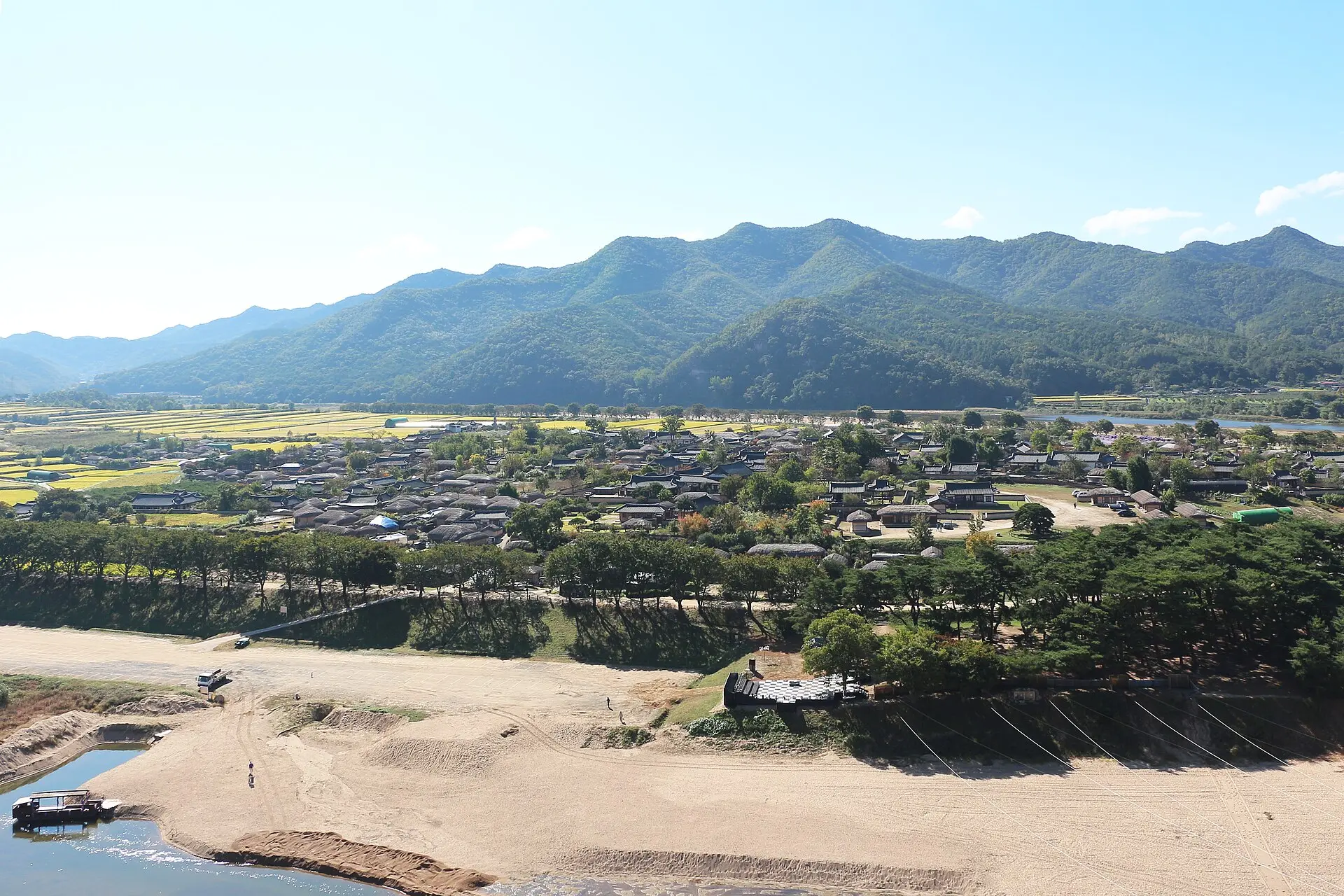
| Andong | Hahoe village (World Heritage 2010) | KTX-Eum from Seoul-Cheongnyangni 1 h 49 min to 2 h 6 min | only 10 trains a day |
| Suwon | Hwaseong Fortress (World Heritage 1997) | KTX from Seoul 34 to 40 minutes | only 8 KTX trains in the timetable |
Swipe the table sideways to see all columns.
Journey times and train numbers: KTX timetable from 1 September 2026, our own analysis. Where “—” appears, the sources give no drawback.
Seoul: five sites, one combined ticket
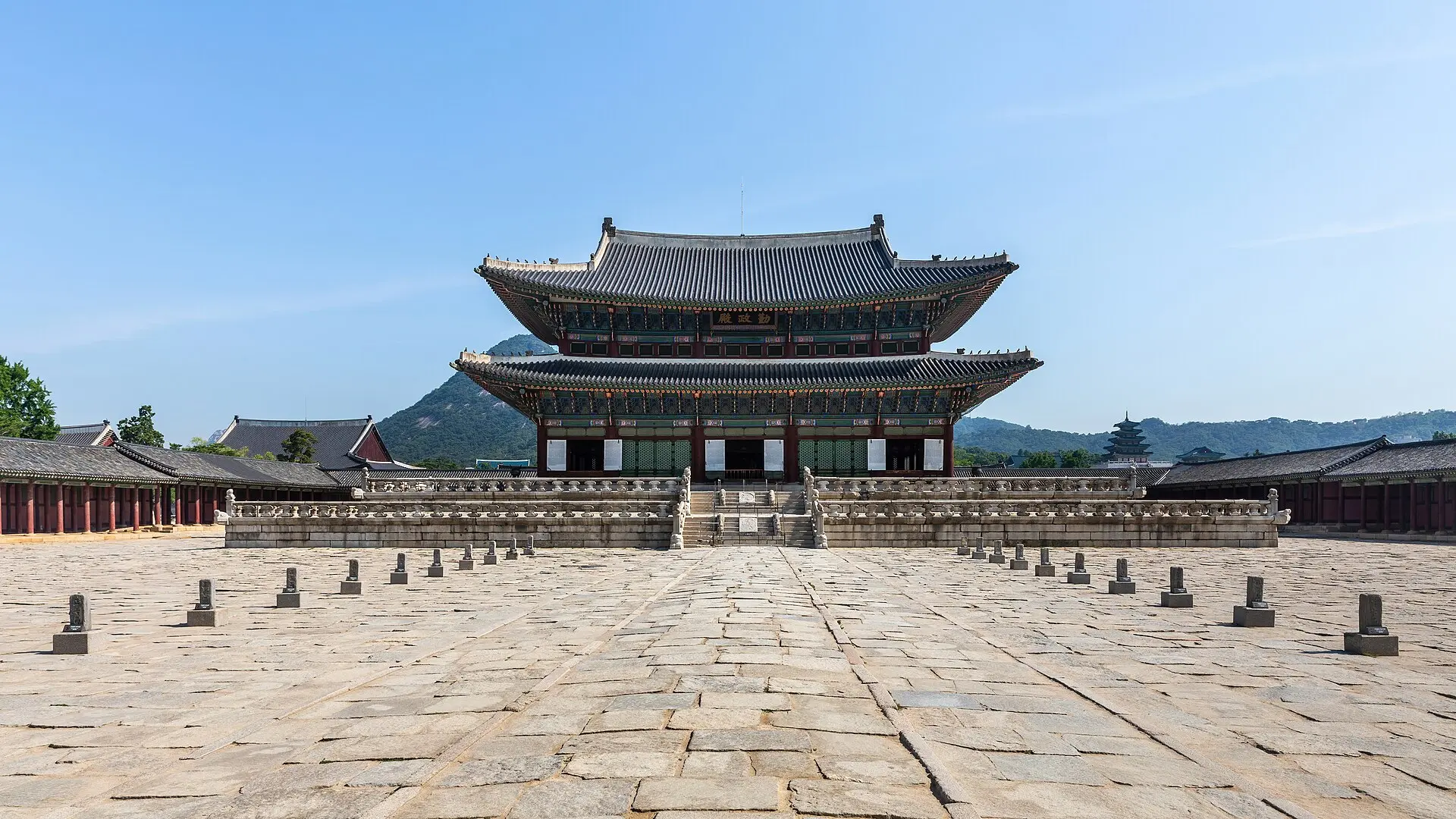
Gyeongbokgung and Changdeokgung cost foreign adults aged 19 to 64 3,000 won each, Jongmyo, Deoksugung and Changgyeonggung 1,000 won each (as of September 2026). The rear garden Huwon in Changdeokgung costs 5,000 won extra, only together with a palace ticket. Gyeongbokgung and Jongmyo are closed on Tuesdays, the other palaces on Mondays. Deoksugung and Changgyeonggung are open until 21:00. Until 31 October 2026, access to the terrace in front of the throne hall at Gyeongbokgung is restricted.
Tip
Palaces free of charge in a hanbok
In South Korea you get into the royal palaces of Seoul free of charge in a hanbok, including as a visitor from abroad (as of September 2026). It has to be a jacket and a skirt or trousers; jeans with a jacket do not count. Without a hanbok, the combined ticket for four palaces and the Jongmyo Shrine costs 6,000 won, valid for one visit each within six months. On the last Wednesday of the month admission is free for everyone. The Huwon costs extra in both cases.
Busan: subway, bus and ferries
Busan has four subway lines with announcements in English too (as of September 2026). The city bus costs 1,550 won with a transport card and 1,700 won in cash, and then without a transfer discount (fare since 6 October 2023). To Japan you go by ship from the International Ferry Terminal, for example to Fukuoka or Osaka.
Gyeongju: World Heritage twice
Gyeongju appears on the World Heritage list twice: with the Seokguram Grotto and Bulguksa Temple since 1995 and with its Historic Areas since 2000. The KTX from Seoul Station usually costs 44,500 won in standard class (fare from 1 September 2026).
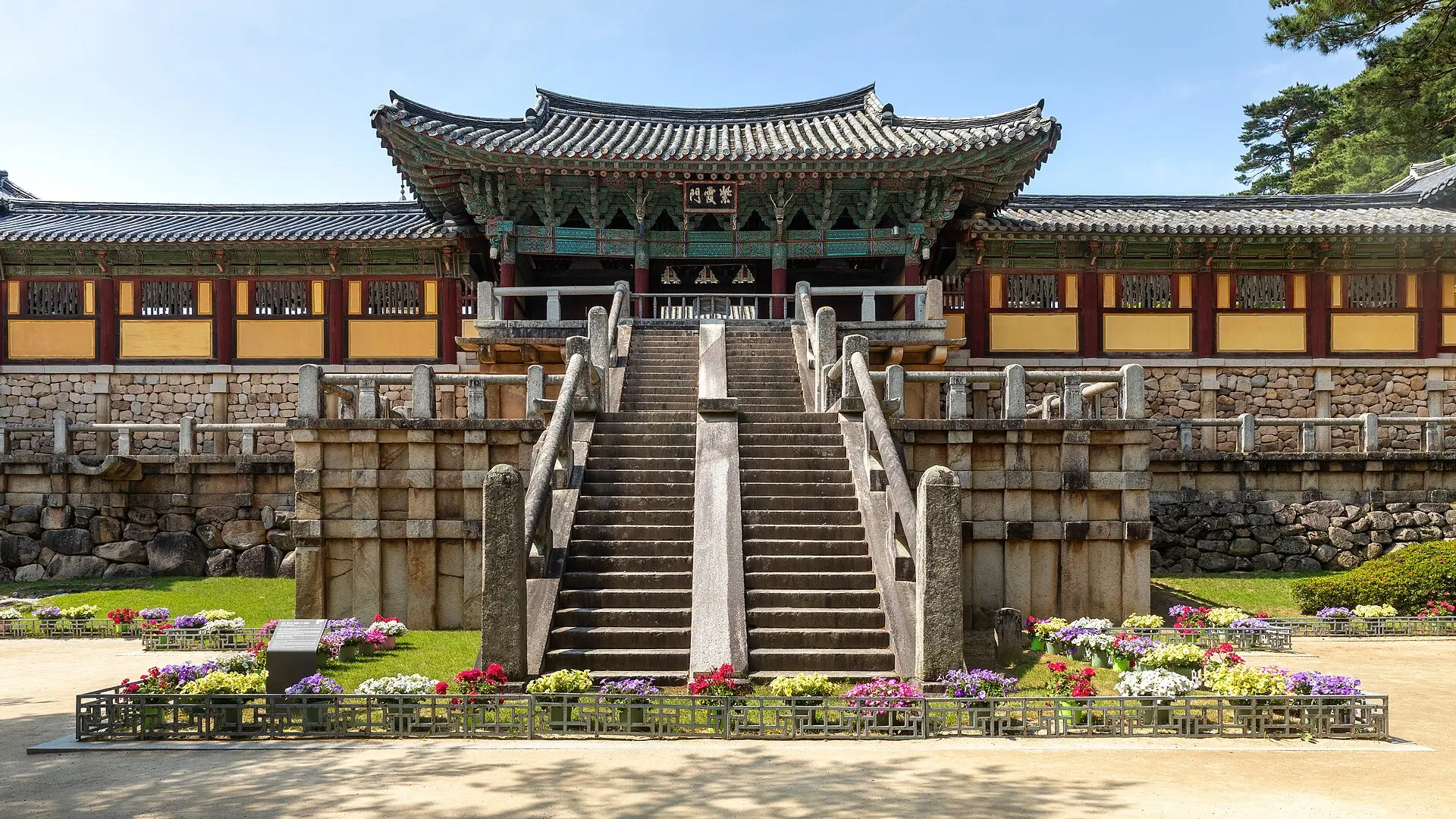
Jeju: tuff cone and Hallasan
The volcanic island of Jeju has been a World Heritage Site since 2007. The 180 m high tuff cone Seongsan Ilchulbong was built up around 5,000 years ago by a volcanic eruption in shallow seawater. Adults aged 25 to 64 pay 5,000 won; it is closed on the first Monday of the month (as of September 2026). The bus from Jeju airport takes about 70 minutes.
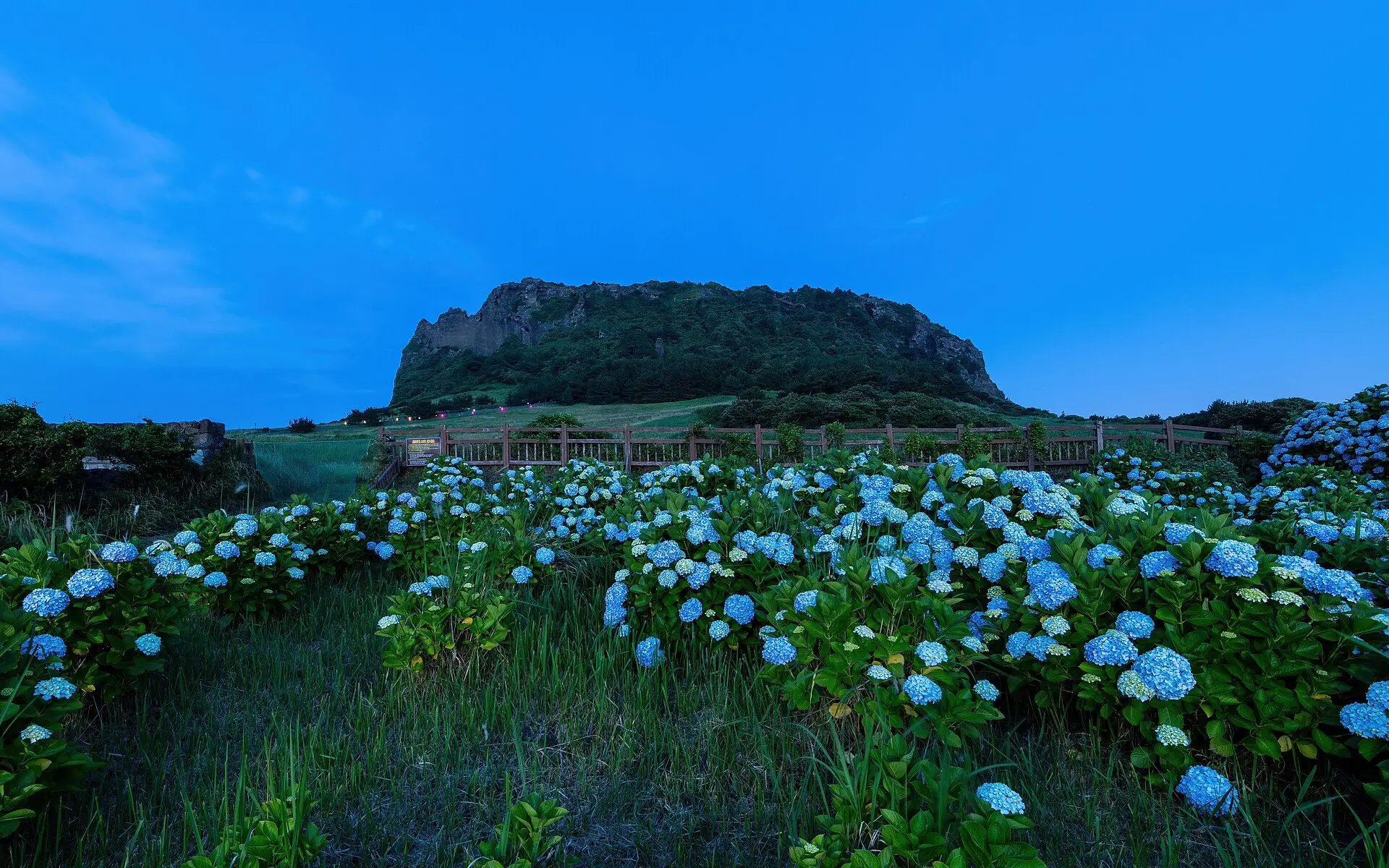
The Seongpanak and Gwaneumsa trails lead to the summit of Hallasan. Since May 2025 you have needed a reservation only for the upper section from Jindallaebat or Samgakbong. You can walk Eorimok, Yeongsil and the other trails without a reservation (as of September 2026). For the 9.6 km from Seongpanak to the summit, the national park reckons on about four and a half hours in each direction.
Caution
Hallasan: no-shows are banned
Booking opens at 9:00 on the first working day of the previous month, with a maximum of 4 people per booking. Unexcused absence leads to a booking ban: 3 months the first time, one year the second time (as of September 2026).
Best time to visit
The table shows 1991–2020 normals from the weather service KMA, published by the WMO, for the stations Seoul (85.67 m) and Busan (69.56 m).
| Month | Seoul: mean max / min (°C) / rain (mm) | Busan: mean max / min (°C) / rain (mm) |
|---|---|---|
| January | 2.1 / −5.5 / 16.8 | 8.2 / −0.1 / 34.5 |
| February | 5.1 / −3.2 / 28.2 | 10.2 / 1.5 / 49.6 |
| March | 11.0 / 1.9 / 36.9 | 13.8 / 5.3 / 89.7 |
| April | 17.9 / 8.0 / 72.9 | 18.2 / 10.1 / 140.9 |
| May | 23.6 / 13.5 / 103.6 | 22.0 / 14.6 / 155.9 |
| June | 27.6 / 18.7 / 129.5 | 24.6 / 18.3 / 188.4 |
| July | 29.0 / 22.3 / 414.4 | 27.5 / 22.1 / 326.8 |
| August | 30.0 / 22.9 / 348.2 | 29.5 / 23.7 / 266.5 |
| September | 26.2 / 17.7 / 141.5 | 26.4 / 19.8 / 160.6 |
| October | 20.2 / 10.6 / 52.2 | 22.5 / 14.5 / 79.6 |
| November | 11.9 / 3.5 / 51.1 | 16.6 / 8.3 / 50.4 |
| December | 4.2 / −3.4 / 22.6 | 10.4 / 2.0 / 33.8 |
Swipe the table sideways to see all columns.
The Jangma rainy season begins on average on 19 June on Jeju and on 25 June in the middle of the country and lasts about a month. According to KMA, an average of 3.4 typhoons a year affect the weather in South Korea, 3.0 of them between July and September (normals 1991–2020). In winter it is cold and dry, according to KMA.
Getting around the country
Train: one KTX network since September 2026
Since 1 September 2026 Korail has run KTX and SRT together as KTX, and the former SRT trains are now called “KTX-Sancheon”. Since then there have been 402 instead of 379 services on weekdays. You book all express trains from Seoul Station, Suseo and Yongsan in the “Korail+” app (as of 18 September 2026).
Seoul–Busan takes 2 hours 18 minutes to 3 hours 27 minutes. The first train from Seoul leaves at 5:13, the last daily one at 22:28 (timetable from 1 September 2026). In 1st class the route costs 78,900 won (fare from 1 September 2026). From a delay of 120 minutes for which Korail is responsible, you get the full fare back (as of 18 September 2026).
Tip
KTX: rebooking free of charge
Since 1 September 2026 the KTX from Seoul to Busan costs 54,400 instead of 59,800 won in standard class. You can rebook free of charge to a train up to 7 days before or after your travel day. If you cancel within the first 10 minutes after paying, that is also free (as of 18 September 2026).
Bus and local transport
Long-distance buses run, for example, from Busan to Seoul and to Incheon airport (as of September 2026). Prices and journey times are missing from the sources we evaluated.
A subway ride in Seoul costs 1,550 won up to 10 km with a transport card (as of September 2026). Cards such as T-money are available in convenience stores and subway stations. If you change between subway and bus within 30 minutes, you pay less if you also hold the card to the reader when getting off the bus. According to the city, Apple Pay does not yet work as a ticket.
Tip
Climate Card: three days of subway and bus for 10,000 won
The City of Seoul's short-term pass costs 5,000 won for one day, 10,000 for three days and 20,000 won for seven days (as of September 2026). The card itself costs 3,000 won once; since 20 March 2025 you can pay with a foreign credit card. Airport and intercity buses are not included.
Car and roads
South Korea drives on the right. With an International Driving Permit under the Geneva (1949) or Vienna (1968) convention, you may drive for one year from entry. The limit is 0.03% blood alcohol, i.e. 0.3 per mille (Road Traffic Act, version from 1 July 2026).
Motorways allow 80 km/h with one lane in each direction, 100 km/h from two lanes and 120 km/h on designated sections. In residential, commercial and industrial areas 50 km/h generally applies. On wet roads every limit drops by a fifth (regulation, version from 24 August 2026).
Money and costs
You pay in won (KRW), with notes from 1,000 to 50,000 won. According to the Bank of Korea, only about 10% of the payment value in shops was in cash, compared with almost 35% in countries such as Germany (as of 2023, report 2024).
In tax-free shops you get the tax refunded from 15,000 won per purchase. For purchases under 1 million won the shop may deduct it directly at the till. That applies as long as your purchases with immediate deduction since entry total at most 5 million won (regulation, version from 2 January 2026). The departure tax is 7,000 won when leaving by air; children under 12 are exempt (as of September 2026).
| Item | Price | As of |
|---|---|---|
| AREX direct train Incheon–Seoul Station | 13,000 won | September 2026 |
| Subway Seoul up to 10 km | 1,550 won with transport card | September 2026 |
| Climate Card for 1 / 3 / 7 days | 5,000 / 10,000 / 20,000 won | September 2026 |
| KTX Seoul–Busan, standard class | 54,400 won | since 1 September 2026 |
| Gyeongbokgung | 3,000 won | September 2026 |
| Combined ticket four palaces and Jongmyo | 6,000 won | September 2026 |
| Seongsan Ilchulbong | 5,000 won | September 2026 |
| Haenggung with Hwaryeongjeon, Suwon | 2,000 won | since 1 February 2025 |
| Departure tax by air | 7,000 won | September 2026 |
Swipe the table sideways to see all columns.
Practical information
South Korea runs on UTC+9 without daylight saving time. In the German winter it is 8 hours later there, during German summer time 7 hours (our own calculation). The official language is Korean. The sockets are type C and F as in Germany, with 220 V and 60 Hz (IEC, as of 23 December 2024). The EU roaming rule does not apply in South Korea, so mobile data can become expensive (as of September 2026).
You reach the ambulance and fire service on 119 and the police on 112. The tourist hotline 1330 with an interpreting service is available around the clock (as of September 2026).
The longest public holidays are Seollal and Chuseok, with three days each. In 2027 Seollal falls on 6 to 8 February, with 9 February added as a substitute day (our own calculation); Chuseok follows from 14 to 16 September.
The current rules on entry, safety and health are at the German Foreign Office.
Entry requirements and safety
The rules that apply are published by the German Federal Foreign Office — always up to date there.
Travel and safety advice: South Korea (in German) (opens in a new tab)Who South Korea is not for
- Anyone who avoids mugginess and constant rain: In July Seoul receives 414.4 mm of rain on 16.3 days, and humidity reaches 78 to 79% on a national average in July and August.
- Anyone who has to plan firmly in late summer: In July, August and September an average of 1.0, 1.2 and 0.8 typhoons affect South Korea (KMA, 1991–2020).
- Anyone who avoids cold and can only go in January: In Seoul the mean minimum is then −5.5 °C and the maximum 2.1 °C.
- Anyone who wants to go to Hallasan or the Huwon spontaneously: The summit is possible only with a reservation, and Huwon tickets sell out quickly in spring and autumn.
- Anyone who wants to get to Busan or Jeju without a connecting leg: In 2025 almost all passengers from Germany had Seoul-Incheon as their last known destination, Busan only 678 and Jeju 429.
Sources and last update
- Statistical report: air traffic at main airports, July 2026, table 46421-09 “Boarding passengers by destination airport (last known destinations)” (Federal Statistical Office (Destatis), in German) (opens in a new tab), accessed 27 September 2026
- Republic of Korea (South Korea): travel and safety advice (German Foreign Office, in German) (opens in a new tab), accessed 27 September 2026
- Direct train: journey times and fares (AREX Airport Railroad) (opens in a new tab), accessed 27 September 2026
- Direct train: timetable (AREX Airport Railroad) (opens in a new tab), accessed 27 September 2026
- Commuter train: journey times (AREX Airport Railroad) (opens in a new tab), accessed 27 September 2026
- Commuter train: fares (AREX Airport Railroad) (opens in a new tab), accessed 27 September 2026
- Home page with terminal allocation of the airlines (AREX Airport Railroad) (opens in a new tab), accessed 27 September 2026
- Inter-Terminal Transportation (Incheon International Airport Corporation) (opens in a new tab), accessed 27 September 2026
- Republic of Korea: Properties inscribed on the World Heritage List (UNESCO World Heritage Centre) (opens in a new tab), accessed 27 September 2026
- 48th session of the World Heritage Committee, Busan 2026 (UNESCO World Heritage Centre) (opens in a new tab), accessed 27 September 2026
Show all 50 sources
- Opening hours of the palaces and Jongmyo (Royal Palaces and Tombs Center, Korea Heritage Service) (opens in a new tab), accessed 27 September 2026
- Admission prices of the palaces and Jongmyo (Royal Palaces and Tombs Center, Korea Heritage Service) (opens in a new tab), accessed 27 September 2026
- Free admission in hanbok: guideline (Royal Palaces and Tombs Center, Korea Heritage Service) (opens in a new tab), accessed 27 September 2026
- Gyeongbokgung: announcements (Royal Palaces and Tombs Center, Korea Heritage Service) (opens in a new tab), accessed 27 September 2026
- Public Transportation (Busan Metropolitan City) (opens in a new tab), accessed 27 September 2026
- Seongsan Ilchulbong: introduction and visitor information (Jeju Special Self-Governing Province) (opens in a new tab), accessed 27 September 2026
- Hallasan: reservation (Hallasan Visit Reservation System, Jeju) (opens in a new tab), accessed 27 September 2026
- Guidelines on the adjustment of the reservation section of Hallasan National Park, 12 May 2025 (Hallasan Visit Reservation System) (opens in a new tab), accessed 27 September 2026
- Seongpanak Trail (Hallasan Visit Reservation System) (opens in a new tab), accessed 27 September 2026
- Jeonju Hanok Village: facts and figures (City of Jeonju) (opens in a new tab), accessed 27 September 2026
- Notice of change in fees for Suwon Hwaseong Fortress facilities, 8 Jan 2025 (Suwon Cultural Foundation) (opens in a new tab), accessed 27 September 2026
- Express train fares from 1 Sep 2026, fare table (SR) (opens in a new tab), accessed 27 September 2026
- Express train timetable from 1 Sep 2026 (SR) (opens in a new tab), accessed 27 September 2026
- Merger of the express rail operations: what has changed in rail service, press release of 18 Sep 2026 (Korail) (opens in a new tab), accessed 27 September 2026
- From 1 September KTX Seoul–Busan 54,400 won, fares 10% lower on average (Hankyung, 31 Aug 2026) (opens in a new tab), accessed 27 September 2026
- World Weather Information Service: Seoul, climate data 1991–2020 (WMO, KMA data) (opens in a new tab), accessed 27 September 2026
- World Weather Information Service: Busan, climate data 1991–2020 (WMO, KMA data) (opens in a new tab), accessed 27 September 2026
- OSCAR/Surface: Station SEOUL 0-20000-0-47108 (World Meteorological Organization) (opens in a new tab), accessed 27 September 2026
- OSCAR/Surface: Station BUSAN 0-20000-0-47159 (World Meteorological Organization) (opens in a new tab), accessed 27 September 2026
- Climate of Korea: characteristics (Korea Meteorological Administration) (opens in a new tab), accessed 27 September 2026
- Typhoon statistics (Korea Meteorological Administration) (opens in a new tab), accessed 27 September 2026
- Road Traffic Act (도로교통법), version from 1 Jul 2026 (Korea Ministry of Government Legislation) (opens in a new tab), accessed 27 September 2026
- Enforcement decree of the Road Traffic Act, version from 24 Aug 2026 (Korea Ministry of Government Legislation) (opens in a new tab), accessed 27 September 2026
- Public Transportation (Seoul Metropolitan Government) (opens in a new tab), accessed 27 September 2026
- Climate Card (Seoul Metropolitan Government) (opens in a new tab), accessed 27 September 2026
- Introduction to Banknotes (Bank of Korea) (opens in a new tab), accessed 27 September 2026
- Payment and Settlement Systems Report 2024 (Bank of Korea) (opens in a new tab), accessed 27 September 2026
- Special decree on tax refunds for foreign tourists, version from 2 Jan 2026 (Korea Ministry of Government Legislation) (opens in a new tab), accessed 27 September 2026
- Enforcement rules of the special decree on tax refunds, version from 2 Jan 2026 (Korea Ministry of Government Legislation) (opens in a new tab), accessed 27 September 2026
- Decree on the Tourism Promotion Fund, departure levy (Korea Ministry of Government Legislation) (opens in a new tab), accessed 27 September 2026
- Standard Time Act (Korea Ministry of Government Legislation) (opens in a new tab), accessed 27 September 2026
- § 4 Units and Time Act: statutory time (Federal Ministry of Justice, in German) (opens in a new tab), accessed 27 September 2026
- Framework Act on the Korean Language, version from 3 Sep 2026 (Korea Ministry of Government Legislation) (opens in a new tab), accessed 27 September 2026
- Decree on the Disaster and Safety Act, emergency numbers, version from 22 Jul 2026 (Korea Ministry of Government Legislation) (opens in a new tab), accessed 27 September 2026
- World Plugs, archived copy of 23 Dec 2024 (International Electrotechnical Commission) (opens in a new tab), accessed 27 September 2026
- Roaming: using your smartphone in another EU country (Your Europe, European Union, in German) (opens in a new tab), accessed 27 September 2026
- Public Holidays Regulation (관공서의 공휴일에 관한 규정), version from 11 May 2026 (Korea Ministry of Government Legislation) (opens in a new tab), accessed 27 September 2026
- National Holidays Act (Korea Ministry of Government Legislation) (opens in a new tab), accessed 27 September 2026
- Lunar–solar calendar conversion, February 2027 (Korea Astronomy and Space Science Institute) (opens in a new tab), accessed 27 September 2026
- Lunar–solar calendar conversion, September 2027 (Korea Astronomy and Space Science Institute) (opens in a new tab), accessed 27 September 2026
Information last checked on 28 September 2026.
Found a mistake? Write to us — we’ll correct it and note it here.